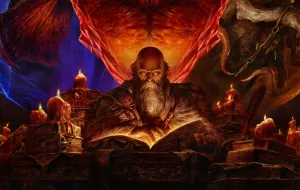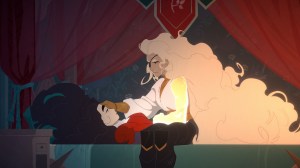
Originally slated for this year, At Fate’s End has been delayed to 2027. And while I’m bummed that the next game from Spiritfarer studio Thunder Lotus is now months (maybe even a year) away, the new Steam demo that dropped alongside the delay announcement has been an excellent consolation prize. Having finished the one-hour slice of the upcoming action-adventure, I’m more convinced than ever that this game would have been a serious contender for everyone’s Best Of lists this year had it managed to stick to its original release window.
Like Spiritfarer, At Fate’s End appears to combine an engrossing gameplay loop with an emotionally devastating story. However, unlike Spiritfarer, At Fate’s End isn’t delving into death positivity and the oftentimes messy emotions of grief, vulnerability, and forgiveness tied to the loss of a loved one (on first glance anyway–I suppose it could always touch on these).

Instead, the game tells the story of how a family’s fracturing loyalties can cause members to turn on one another, why the long-ignored traumas between parents and their children can linger and continue to hurt long after a parent dies, and what it takes for siblings to reopen old wounds and unearth buried insecurities so that their relationships can heal correctly and find a healthier path forward.
I’m convinced this game is going to emotionally destroy me even more than Spiritfarer did, and I simply cannot wait for it to do so.
In At Fate’s End, you play as Shan Hemlock, the youngest and most inexperienced knight in a family of warriors. Chosen by her mother to be the next princess of blades just before the queen’s death, Shan has returned to her family’s home to set out across the various kingdoms ruled by her siblings to take away their swords, the source of each of their magical abilities, in order to become the next ruling monarch.
These duels see Shan cross swords with her siblings in real-time action-platforming combat, but each phase of the fight is marked by both sides pausing to spout words at one another. These moments are chances for you to pick the right dialogue choices to emotionally cut at Shan’s siblings, strategically dismantling their resolve, and convince them that they aren’t worthy to wield the sword they do.
Failing to win these clashes of words leads to Shan’s siblings lashing out and hurting her, making the next phase more challenging for you (or maybe just outright killing Shan if her hit points are low enough), while successfully dismantling Shan’s sibling’s resolve carves out a chunk of their health to help make the next phase less strenuous to fight your way through.
These conversations make these duels exactly as emotional as you imagine them to be, especially if you’re someone with firsthand experience of having a complicated relationship with your sibling(s) and you know how it feels to push a line you maybe shouldn’t or concede an argument at the detriment of your own self-care out of love for someone important to you.
Adding to these conflicts is the importance of the duels. In the demo, you face off against Camilla, Shan’s older sister and an accomplished warrior who has buckled under the weight of the responsibility of leadership and the toll of wielding a weather-controlling sword that she never wanted. The pressure has led her to become a drunk that none of her subjects are brave enough to challenge.
She doesn’t know people are scared of her, though. Since no one has complained to her about anything since she helped out some farmers a few years prior, she’s convinced she’s a good ruler. Only by investigating her castle, exploring the nearby woods, and talking to the citizens in the town under her command did I slowly uncover the reality. There are decaying buildings and monster-filled woods. And, worse of all, there’s a lingering trepidation in the air. The people both fear and hate your sister, a woman who killed a lot of people when she accidentally misused her sword and created a flood in response to the farmers’ request for rain during her very first weeks of rule.
These investigations play out in 2.5D environments in which you talk to other characters, solve puzzles, and complete combat challenges. In battle, Shan is capable of performing all the trademarks of an action hero–jumping, slashing, blocking, and charge-attacking–but her skillset develops through meeting her family. Learning more about Shan’s extended family nets you in-game currency used to unlock nodes on a skill tree, each of which represents the trademark skill of a member of her extended family. Shan can better embody the cowardice of a particular cousin to perform a block in midair, for example.
An even more crucial component is Shan’s tarot deck. The major arcana cards in the deck each embody powerful skills that Shan is able to use depending on how they’re played. At Fate’s End isn’t quite a deckbuilder. There don’t seem to be enough cards to unlock to make it one, but it borrows from that genre. You’re incentivized to seek out the major arcana cards of a tarot deck to customize how Shan can explore the world and fight enemies.
Some of the major arcana allow Shan to affect the world state to change how the game works or aid in solving environmental puzzles–equipping Death makes combat harder for those who want to test themselves in more challenging battles, for instance, while donning The Moon transforms the overworld from day to night. But the ones she unlocks by meeting with her siblings are the big game-changers. Interacting with Camilla for the first time gives you The Chariot, while meeting your older brother Roman in Camilla’s forest gives you The Devil. If The Chariot is equipped, Shan can briefly pause time and teleport to anywhere on the screen–a great skill for getting out of the way of unblockable attacks or quickly speeding through small openings. However, flipping The Chariot while equipped replaces this ability with a double-jump. The Devil works the same way, and presumably the rest of the major arcana associated with Shan’s siblings will, too.
This creates a way of customizing Shan to fit your ideal build. But, more importantly, this feature is deliciously thematic. I love that Shan’s greatest power is learning from her family, but she can also subvert her siblings’ skills to create new abilities all her own.
My one problem with the demo was how straightforward it was to get through. I’m hoping the full game increases the complexity of the investigations and dialogue clashes. Looking into Camilla’s shortcomings is fairly uncomplicated, and the game leads you by the hand through most of it. When you do finally cross swords with Camilla, the choice of what to say to achieve an advantage is overwhelmingly obvious–not only is Camilla clearly in the wrong, but knowing how to talk her down doesn’t take much deduction.
This opening hour might be simple to make the first encounter in the game more approachable and best convey the basics of the overall gameplay loop. The opening hour of At Fate’s End feels like the opening hour of Cris Tales or Cabernet (or, perhaps a better comparison, Spiritfarer) in how easy it is to know what to do next. Now, I love those games, so here’s hoping that parallel holds and the later chapters of At Fate’s End lean into the complexities, red herrings, and multi-step deductions that make the overall mysteries and side quests of Cris Tales and Cabernet so compelling to unravel. Trailers for the game imply this complexity will be there later on, but we’ll have to wait for the full release to see.
That shortcoming aside, At Fate’s End is already shaping up to be incredible, and this demo is all I need to know that it’s likely to be one of my favorite games next year. And I’m not just saying that because all the characters speak in a minimalistic nonsense language and the main heroine is a warrior princess who dresses in all red, uses a needle-like sword, and (after undergoing a magical-girl transformation) has stark white hair. I mean, sure, this game looks and sounds a whole bunch like Hollow Knight Silksong sometimes, but my love and appreciation for both games is pure coincidence. Probably.
About The Author